Life Writing and the Southern Hemisphere
From Patagonia in South America, through southern Africa, to Australia and New Zealand and as far down as Antarctica, this collection brings together writers and scholars in the oceanic humanities, postcolonial, and polar studies, and presents works on human, animal and plant life captured in words, music, performance, visual arts and photography. Interdisciplinary and vast in its comparative range, Life Writing and the Southern Hemisphere convenes a diversity of perspectives and positions that demonstrate that the south has rich internal knowledge sources of its own, allowing us to better conceptualise the planet ‘from below’.
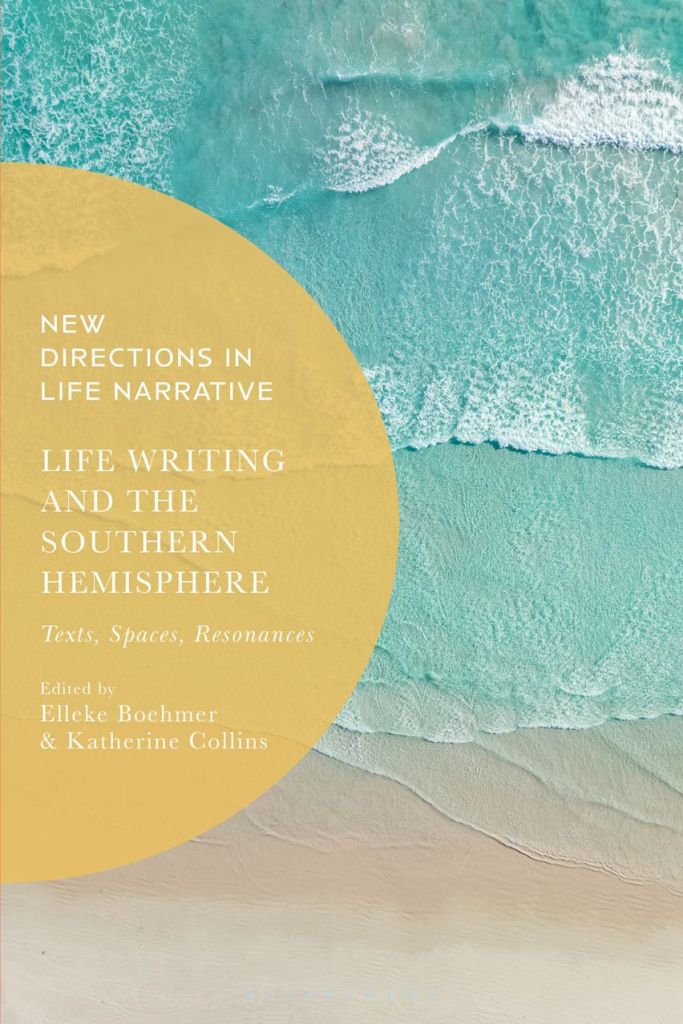
Originally, my essay in this collection was going to be about the so-called ‘absent subjects’ of the South, and the range of issues that arise when we try to write their lives in ways that draw on ‘northern’ notions of time, identity, and self. But in the end, I chose to write about something a little different. Influenced by the workshops we organised, especially an object handling session in the Pitt Rivers, I found myself reflecting on something more fundamental: the prevailing idea of lines, both physical and conceptual, that apparently divide the north from the south. I wrote about how, for various historical and geographical reasons, these lines tend to have been drawn in, or to cut across, the ocean. At 80% water, the southern hemisphere is, of course, the watery hemisphere. And, if you think about it, everything that has come to us here in Oxford from the South, has come over water. Read more on ResearchGate…
Travelling women
Immeasurable Events
A Far Away and Nameless State: The Travel Narratives of Frieda Lawrence and Caitlin Thomas. Not I But the Wind … and Leftover Life to Kill, the somewhat obscure mid-twentieth-century memoirs by Frieda Lawrence and Caitlin Thomas, were written, at least in part, in the countries that the authors eventually made their permanent home: New Mexico and Italy, respectively. While neither was marketed as a ‘travel book’, both works share many of the characteristics Read more…
Rebecca Elson seems always in between. As an astronomer, she studied globular clusters, spherical collections of stars bound by gravity, which contain some of the most ancient stars in the galaxy. In photographs, globular clusters look like someone has popped the lid off a pot of silver glitter and upturned it onto black velvet: a dense sparkling mountain in the centre, diffusing to specks. As a poet Elson moved between inner and outer worlds, between the vastness of the sky and Read more…
Silence fiction
Material metaphors
Biofiction can be defined as fiction about a named, real person and is characterised by creativity, invention, and imaginative exploration. In this essay I deploy a mixture of nonlinear narrative and theoretical writing to explore the argument that creative ways of responding to archival silences illuminate, and also complicate, our attempts to recover women’s lives from obscurity. As the text evolves, the narrative sections become more invented, something more like fiction. Read more…
Often there is no space in my favourite café with its walls of textured teal, thronged with faces that may have meant something once to people who’ve long since donated the quirky paintings and photos to a charity shop. Anyone can find their place among them, bending or stretching to frame a new face in one of the pitted art deco mirrors. Even the rickety tables in the middle, little inhospitable islands buffeted by passing elbows and rucksacks, are full. . Read more…
Hinterlands
The pain began at 5am, after a night of fitful rest and vivid dreams. In bed, lying on my left side, facing the white lacquered built-in cupboard lined with shiny green and pink 1980s wallpaper. The cupboard is too narrow to be useful but we can’t change it, it’s not our cottage. Later I sit bolt upright on the sofa, like a suspect in an interview room. Where were you on the afternoon of the twelfth of November? By that time I was on the way, travelling Read more…
The lille diaries
Back to the beach
I slipped this slim, unassuming little volume into my bag, planning to have a look during my daughter’s swimming lesson. I pulled it out – pleasantly solid and tactile, with crisp cream pages – while perched on the unyielding plastic of the pull-down seat in the stuffy, chlorine-scented spectator area. As I began to read, the muffled hum of screeches and splashes faded away into the thick air, to be replaced in my mind with the sights and smells of the 17th century Couvent des Minimes in Lille. Read more…
On illegitimate texts
I can’t make up stories even when there are props. A miniature pair of glasses, like the ones John Lennon and Ghandi wore. A miniature candlestick, a small square yellow sponge, a white cardboard circle and a navy blue elastic hairband. The first thing I wanted to do, I don’t know why, is put the circle inside the hairband. It took some fiddling, but I made it fit. Was this a strategy to give me more time to make up my story? It might have been. Read more…
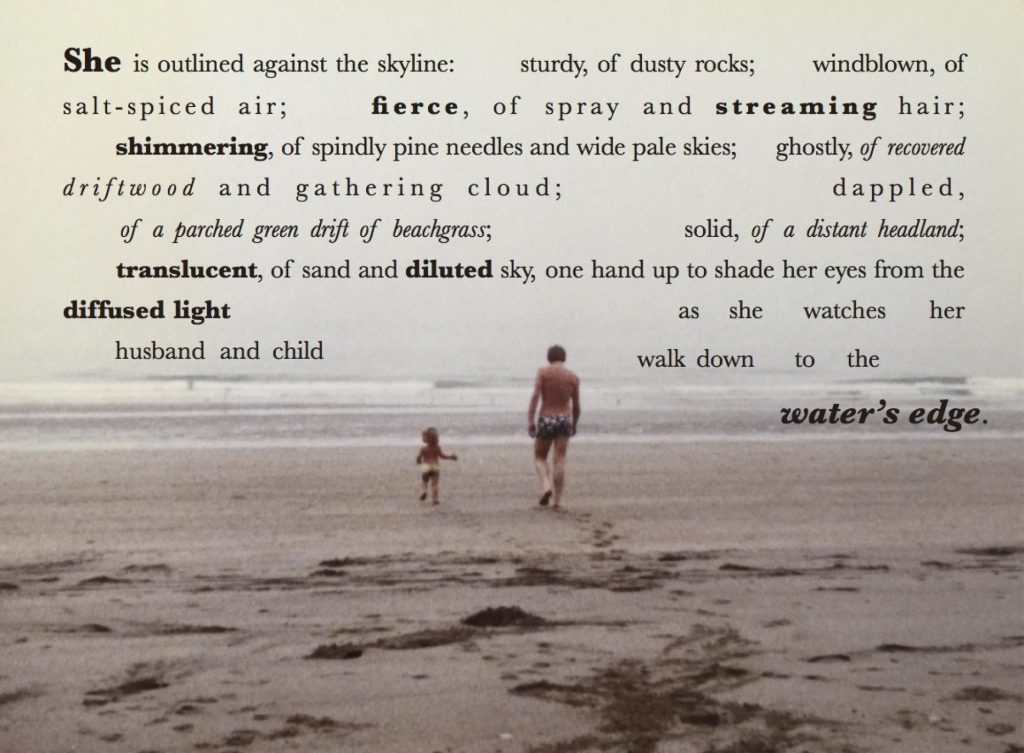
This lyric essay was inspired by the relationship between a landscape and the narratives by which we understand our lives. The photographs came first: family snapshots discovered in dusty cardboard boxes under beds; in heavy brown albums with sticky pages, held in place by fragile, statically charged plastic sheets; in carefully organised and backed-up files; and then hundreds, drifting chronologically through gigabytes of iClouds…Scanned, assembled in virtual space. Themed, grouped in categories like light and water. Unthemed again. Read more…
 Katherine Collins